Q) Compute the sign of an integer?
The MSB bit of a number defines their sign. If the MSB bit is set, the number will be negative.
Q) Detect if two integers have opposite signs?
The two integers have different signs if their MSB (bit) is different. Using the EX-OR operator, we can check the sign of the integers.
We know that for the same input EX-OR produces the low output and for the different input it produces the high output.
E.g.
| BIT1 | BIT2 | BIT1 ^ BIT2 |
| 1 | 1 | 0 |
| 0 | 0 | 0 |
| 1 | 0 | 1 |
| 0 | 1 | 1 |
Let the given integers are “a” and “b”. The EX-OR of sign bit (MSB) of “a” and “b” will be 1 if the MSB of “a” and “b” is different. In other words, we can say, EX-OR of “a” and “b” will be negative if “a” and “b” have the opposite signs.
Q) Write a program to check an integer is a power of 2?
Here, I am writing a small algorithm to check the power of 2. If a number is a power of 2, the flag will be 1.
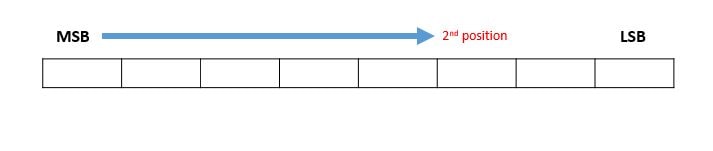
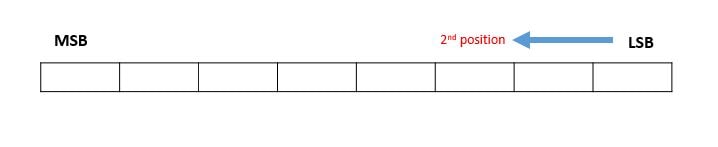
Note: Here I assume that bit of register starts with 0th position, it means the 2nd position is actually 3rd bits.
| D7 | D6 | D5 | D4 | D3 | D2 | D1 | D0 |
Q) How to set a particular bit in C?
Setting a Bits
Bitwise OR operator (|) use to set a bit of integral data type.”OR” of two bits is always one if any one of them is one.
An algorithm to set the bits
Number | = (1<< nth Position)
A simple program to set a bit:
Q) How to clear a particular bit in C?
Bitwise AND operator (&) use to clear a bit of integral data type. “AND” of two bits is always zero if any one of them is zero.
An algorithm to clear the bits
Number &= ~ (1<< nth Position)
To clear the nth bit, first, you need to invert the string of bits then AND it with the number.
A simple program to clear a bit:
Q) How to check if a particular bit is set in C?
To check the nth bit, shift the ‘1’ nth position toward the left and then “AND” it with the number.
An algorithm to check the bits
Bit = Number & (1 << nth)
A simple program to check a bit:
Q) How to toggle a particular bit in C?
Bitwise XOR (^) operator use to toggle the bit of an integral data type. To toggle the nth bit shift the ‘1’ nth position toward the left and “XOR” it.
An algorithm to toggle the bits
Number ^= (1<< nth Position)
A simple program to toggle a bit:
Q) Write an Efficient C Program to Reverse Bits of a Number?
There are a lot of ways to reverse the bits of a number, here I am describing three general methods to reverse the bits.
Method 1:
In this method, we will check the set bits of num and run the loop through all the bits of an integer. If we find the ith bits of num is set then just put 1 at the ((INT_BITS – 1) – ith ) position of tmp, where INT_BITS is the number of bits of an integer.
Method 2:
It is a simple algorithm to reverse bits of the 32-bit integer. This algorithm uses the eight constant value for reversing the bits and takes five simple steps.
In the below section, I am describing the functioning of each step.
Steps 1:
num = (((num & 0xaaaaaaaa) >> 1) | ((num & 0x55555555) << 1));
This expression used to swap the bits.
Let an example, suppose num is 0100, after the above expression it will be 1000.
Steps 2:
num = (((num & 0xcccccccc) >> 2) | ((num & 0x33333333) << 2));
Above expression uses to swap the 2 bits of a nibble. Suppose num is 10 00, after the above expression, it will be 00 01.
Steps 3:
num = (((num & 0xf0f0f0f0) >> 4) | ((num & 0x0f0f0f0f) << 4));
An expression used to swaps the nibbles. like if num is 0011 0010 then after the above expression it will be 0010 0011.
Steps 4:
num = (((num & 0xff00ff00) >> 8) | ((num & 0x00ff00ff) << 8));
This statement uses to swap the bytes of an integer. Let num is 00001000 00001100, after the above expression, it will be 00001100 00001000.
Steps 5:
((num >> 16) | (num << 16));
The above expression uses to swap the half-word of an integer. Means that if the num is 0000000011001110 1000100100000110 after the above result number will be 1000100100000110 0000000011001110.
Q) Write a program to count set bits in an integer?
There are a lot of ways to count the number of bits in a given integer, here I am writing two approaches naive and Brian Kernighan’s.
In naive approach requires one iteration per bit until no more bits are set.
Brian Kernighan’s method goes through as many iterations as there are set bits.
1. Initialize CountSetBits = 0
2. If integer n is not zero.
( a ). Perform bitwise operation and assign the value back to the n.
These bitwise operations clear the least significant.
n &= (n – 1);
( b ). Increment CountSetBits by 1.
( c ). Again go to step 2.
3. If there are no set bits remaining then return CountSetBits.
Q) Rotate bits of a number in C?
Like the assembly in C language, there is no operator to rotate the bits, so if we require rotating a bit, then we have to do it manually.
Basically, bit rotation is similar to the shift operation except that in shift operation the bits that fall off at one end are put back to the other end.
There are two types of rotation possible left and right. In the left rotation, the bits that fall off at the left end are put back at the right end and in the right rotation, the bits that fall off at the right end are put back at the left end.
Example:
If data is stored using 8 bits, then the left rotation of a data 32(00100000) by 2 becomes 128 (10000000). As similar to left rotation, if data is stored using 8 bits, then the right rotation of the data 32(00100000) by 2 becomes 8 (00001000).
Q) Compute the minimum (min) or maximum (max) of two integers without branching?
We can find the minimum (min) or maximum (max) number without the branching with the help of a bitwise operator.
Let’s assume “a” and “b” are integers numbers and “result” is another integer variable that contains the result of the
computation.
So to compute the minimum number we have to write the below expression.
Compute the maximum number we have to write the below expression.
Q) Swap two numbers without using a temporary variable?
Using the EX-OR operator, we can swap two numbers. Here the concept is that EX-OR of two same numbers is zero.
Q) Clear all bits from MSB to the ith bit
Here I have supposed data is stored using 8 bits.
let’s assume the ith position is 2.
mask =(1 <<( i+1)); // give you 00001000
so now if we subtract 1 from the mask (mask = mask – 1), then we will get 00000111
Using the mask, now we can clear MSB to ith bits of data (15).
data = data & mask; // Now bits are clear
Q) Clear all bits from LSB to ith bit
To clear all bits of a data from LSB to the ith bit, we have to perform AND operation between data and mask (flag) having LSB to ith bit 0.
To create a mask, first left-shift 1 (i+1) times.
mask =(1 << (i+1)); // give you 00001000
Now if we minus 1 from that, all the bits from 0 to i become 1 and remaining bits become 0.
mask = mask – 1 ; // give you 00000111
After that perform complement operation on the mask, all the bits from 0 to i become 0 and remaining bits become 1.
mask = ~mask; //give you 11111000
Now just simply perform anding operation between mask and data to get the desired result.
data = data & mask; // Now bits are clear from LSB to ith position
Q) Multiply a number by 2 using bitwise operation
Left shifting of a data (number) by 1 is equivalent to data*2. In data, every bit is a power of 2, with each shift we are increasing the value of each bit by a factor of 2.
Q) Divide a number by 2 using bitwise operation
Right shifting of a data (number) by 1 is equivalent to data/2. In data, every bit is a power of 2, with each right shift we are reducing the value of each bit by a factor of 2.
Q) Multiply a given Integer with 3.5 using bitwise operation
We know that multiplication is basically an addition, so we can multiply a given integer (data) with 3.5 using the following operation, (2 *data) + data + (data/2).
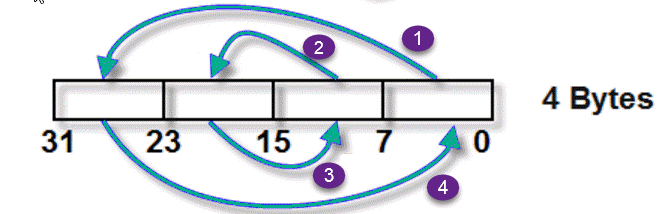
Q) How to change endianness?
In the below image, you can see the conversion.
Q) Swap two nibbles of a byte
A nibble consists of four bits, sometime interviewer asked the question to swap the nibble of a byte. It is a very easy question, here << (left shift) and >> (right shift) operators are used to swap the nibble.
Q) How do I get a bit from an integer value in C?
To get the ith bit, perform Anding operation between the ith bit and 1 (1 << i) after that shift the result ith position in right using the right operation.
Q) Write the macros to set, clear, toggle and check the bit of a given integer.
See the below macro,
- #define SET_BIT(value, pos) value |= (1U<< pos)
- #define CLEAR_BIT(value, pos) value &= ~(1U<< pos)
- #define TOGGLE_BIT(value, pos) value ^= (1U<< pos)
- #define CHECK_BIT_IS_SET_OR_NOT(value, pos) value & (1U<< pos)
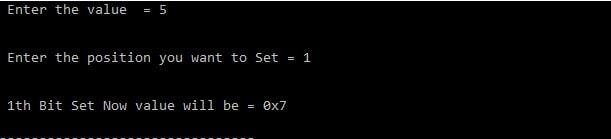
Let see an example to set the bit using the above macro,
Output:
Q) Write MACRO to swap the bytes in 32bit Integer Variable.
I have already written this program in endianness conversion. But here I am creating a Macro for the same.

Q) Swap all odd and even bits
In the above question, you need to swap the even and odd bits. To accomplish the above task you need to first find the even and odd bits then shift these bits. See the below steps,
Let the input number is data (Assuming integer size is 4 bytes),
- Get all even bits of data by doing bitwise and (&) of data with 0xAAAAAAAA (data & 0xAAAAAAAA).
- Get all odd bits of data by doing bitwise and (&) of data with 0x55555555 (data & 0x55555555).
- Right shift all even bits ((data & 0xAAAAAAAA)>>1).
- Left shift all odd bits ((data & 0x55555555)<<1).
- Combine the value which gets from the left and right operation ((data & 0xAAAAAAAA)>>1 | (data & 0x55555555)<<1).
Example code,
Q) Count number of bits to be flipped to convert A to B
In this question, you need to count flipped bits that require to convert A to B. To accomplish this task you need to find the number of bits that are different in A and B.
Algorithm
- Calculate XOR of A and B.With the help of XOR, we will discard the common bits and set the bits that are different in numbers A and B.
- Count the set bits of the above calculated XOR result.
Example code,
Output: Flipped Bits = 4

No comments:
Post a Comment